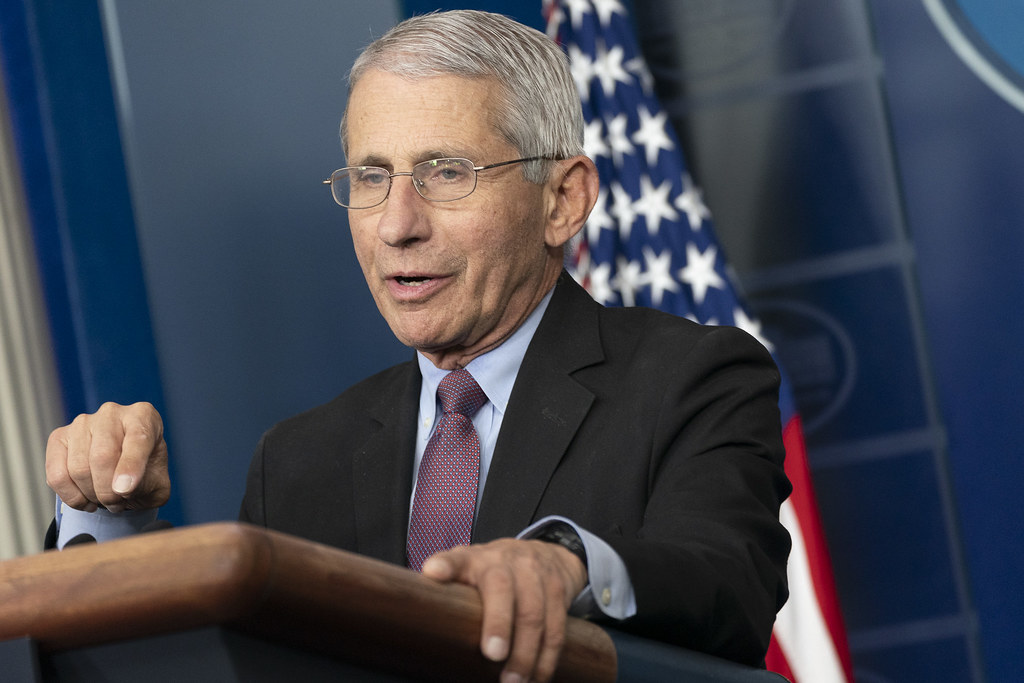
WASHINGTON — Dr. Anthony Fauci repeatedly invoked his Fifth Amendment right against self-incrimination Wednesday during a contentious Senate hearing examining his pandemic-era conduct, federal funding for coronavirus research in China and allegations that he misled Congress about the origins of COVID-19.
Fauci, the former director of the National Institute of Allergy and Infectious Diseases, had been subpoenaed by Republican Sen. Rand Paul of Kentucky, chair of the Senate Homeland Security and Governmental Affairs Committee. The official hearing notice described the proceeding simply as the “Testimony of Anthony Fauci,” without publishing a detailed list of legislative objectives.
The hearing quickly became less an examination of new scientific evidence than a confrontation over possible criminal exposure. Fauci declined to answer more than 100 questions, while Paul announced that the committee would consider a contempt resolution against him next week.
Fauci’s refusal to answer is certain to become a political issue. Legally, however, invoking the Fifth Amendment is not proof that a witness committed a crime. The constitutional protection exists because truthful answers, ambiguous recollections or even minor inconsistencies can be used in a criminal investigation.
That concern was unusually explicit before Wednesday’s hearing. Paul has repeatedly called for Fauci’s prosecution, while Health Secretary Robert F. Kennedy Jr. publicly suggested Fauci could expose himself to a new perjury case if his latest testimony contradicted existing records.
Why did Fauci invoke the Fifth Amendment?
Former president Joe Biden issued Fauci a pre-emptive pardon in January 2025 covering possible federal offences dating from January 1, 2014, through the date of the pardon.
That pardon could protect Fauci from prosecution for covered conduct during the pandemic. It would not necessarily protect him from a new offence allegedly committed afterward, such as making a knowingly false material statement during Wednesday’s hearing.
In an opening statement reported by the Associated Press, Fauci accused Paul of having an “obvious obsession” with prosecuting him. Fauci said he believed the hearing was designed to prompt a statement that could be used to support Paul’s public demands that he be put “behind bars.”
Fauci said he was invoking his constitutional right on the advice of counsel.
His lawyer, David Schertler, attempted to intervene during the hearing and was removed from the room on Paul’s order after speaking without being recognized. Paul warned Fauci that refusing to cooperate could have consequences and later scheduled a committee vote on contempt.
Whether a contempt referral would succeed is uncertain. The legal analysis would depend on whether Fauci had a valid Fifth Amendment basis for refusing each question, whether the committee formally overruled his claims and ordered him to answer, and whether prosecutors chose to pursue the matter.
Congress can compel testimony by granting immunity, but doing so can complicate or foreclose a later prosecution based on the compelled evidence. The committee had not announced such an immunity agreement.
What was the purpose of the hearing?
Paul said the committee was investigating whether Fauci gave false or misleading accounts of several connected matters:
- Whether U.S. taxpayer money supported gain-of-function research at the Wuhan Institute of Virology;
- Whether that research may have contributed to the emergence of SARS-CoV-2;
- Whether Fauci privately considered a laboratory origin more seriously than he acknowledged publicly;
- Whether he influenced intelligence officials or scientists to favour a natural-origin explanation;
- Whether federal officials concealed records or used unofficial communication channels; and
- Whether Fauci’s earlier statements to Congress were truthful.
The hearing followed the release of more than 1,000 pages of Fauci’s pandemic-era diary and a June disclosure by Director of National Intelligence Tulsi Gabbard containing communications about early government discussions of COVID-19’s origins.
Paul argues that Fauci’s private notes reveal greater concern about laboratory research than he conveyed to the public. He has also maintained for years that Fauci falsely denied that the National Institutes of Health funded gain-of-function work in Wuhan.
Fauci denies lying to Congress or concealing the possibility of a laboratory accident. His position has been that he remained open to both natural and laboratory origins, while regarding a natural animal-to-human spillover as better supported by the published scientific evidence.
What do Fauci’s diary entries show?
The diary records the uncertainty inside government during the chaotic opening months of the pandemic. It includes discussions about unusual characteristics of the virus, research conducted in Wuhan and the possibility that the outbreak could be connected to a laboratory.
Those entries are relevant because they establish that Fauci and other officials were discussing a possible laboratory origin early in 2020.
They do not, by themselves, prove that Fauci knew the virus escaped from a laboratory or that he secretly possessed evidence establishing that conclusion.
Uncertainty expressed in private is not necessarily inconsistent with subsequently telling the public that available evidence leaned in another direction. The more consequential question is whether Fauci intentionally misrepresented what he knew, suppressed contrary evidence or directed others to manufacture a conclusion.
The diary’s existence strengthens the case for examining how officials communicated their uncertainty. But quotations expressing concern, without the surrounding scientific discussions and timeline, cannot alone establish deception.
Some of the uncertainty reflected in the notes was already described in Fauci’s 2024 memoir and earlier interviews, according to the Associated Press.
Did the United States fund coronavirus research in Wuhan?
Yes—but that fact is often stated too broadly.
The NIH awarded funding to the U.S.-based nonprofit EcoHealth Alliance. EcoHealth then provided subaward funding to the Wuhan Institute of Virology for work involving bat coronaviruses.
A Government Accountability Office review found that three Chinese institutions, including the Wuhan Institute of Virology, collectively received more than $2 million through seven federal subawards between 2014 and 2021. The amount included multiple institutions and funding sources; it was not all controlled personally by Fauci or spent on one experiment.
The GAO also found genuine oversight weaknesses. NIH did not always ensure that foreign subrecipients complied with award conditions, including requirements that could involve biosafety. EcoHealth submitted a required progress report late, while U.S. authorities had limited access to laboratory records and underlying data in China.
Those are substantiated accountability failures. They support criticism of NIH’s supervision of foreign research and EcoHealth’s grant compliance.
They do not establish that the funded work created SARS-CoV-2.
Was it “gain-of-function” research?
This is the dispute at the centre of Paul and Fauci’s years-long conflict.
“Gain of function” can be used generically to describe research that gives an organism a new or enhanced property. Under that broad scientific meaning, some experiments involving altered viruses can qualify.
The federal government also used a narrower regulatory category for especially dangerous research involving enhanced potential pandemic pathogens. Known as the P3CO framework, it focused on experiments reasonably anticipated to make certain pathogens more transmissible or more dangerous to humans.
Fauci’s earlier categorical statement that NIH “has not ever and does not now fund gain-of-function research” in Wuhan sounded much broader than the regulatory distinction he later said he intended.
That gave Paul an opening to accuse him of lying.
During a 2024 House hearing, acting NIH director Lawrence Tabak acknowledged that the Wuhan work could meet a generic definition of gain of function. Fauci maintained that it did not meet the operative P3CO definition applicable to federal oversight.
The disagreement is therefore partly substantive and partly semantic. NIH-funded experiments altered bat coronaviruses and examined their behaviour. The unresolved legal question is whether Fauci’s choice of the narrower regulatory definition made his testimony knowingly false, merely imprecise or technically accurate within the framework he was discussing.
Perjury requires more than proving that a statement created a misleading impression. Prosecutors generally must prove that the witness knowingly made a false, material statement under oath. Ambiguous terminology and competing technical definitions would be central to any case.
Did NIH-funded research create the pandemic virus?
No publicly released evidence has established that it did.
The viruses identified in reports from the EcoHealth-funded research were genetically too distant from SARS-CoV-2 to be its direct precursor, according to Fauci and other virologists. That does not prove that no different virus existed inside the Wuhan institute; China has not provided all laboratory records and samples sought by investigators.
It means the documented U.S.-funded viruses have not been shown to be the source of COVID-19.
This distinction is essential:
1. U.S. money supported coronavirus research at the Wuhan institute through EcoHealth Alliance. 2. Oversight and reporting surrounding that funding were inadequate. 3. A laboratory-associated origin remains plausible. 4. None of those facts proves that the particular U.S.-funded experiments produced SARS-CoV-2.
The Republican-led House Select Subcommittee on the Coronavirus Pandemic concluded in its December 2024 report that a laboratory-related incident was the most likely origin. It cited Wuhan’s coronavirus laboratories, biosafety concerns, reported illnesses among researchers and the absence of a conclusively identified intermediate animal host.
Those are circumstantial arguments. The committee did not produce a viral sequence, laboratory record, infected researcher’s sample or other direct evidence tracing SARS-CoV-2 to an experiment.
The report also contained partisan disagreements. Republican members treated laboratory origin as the best explanation, while Democratic members said the investigation had failed to connect Fauci or the EcoHealth grant to the creation of the virus.
What is the new intelligence-community accusation?
The most significant new political development came June 18, when Gabbard’s Office of the Director of National Intelligence published documents under the headline, “Fauci Funded Wuhan Lab Research That Sparked COVID.”
ODNI accused Fauci of helping influence intelligence assessments and public narratives toward a natural origin while concealing the implications of research funded by his institute. The agency said whistleblowers had described retaliation against personnel who challenged the intelligence community’s treatment of the lab-origin theory.
Those allegations are serious and deserve independent examination. But the wording of the ODNI release presents disputed conclusions as settled facts. The underlying documents must be evaluated separately from the administration’s characterization of them.
A record showing that Fauci spoke with intelligence officials would not, on its own, prove improper manipulation. As director of the country’s infectious-disease institute and a presidential adviser, consultation with intelligence agencies during a possible biological emergency would have been expected.
Evidence of wrongdoing would require more: for example, proof that Fauci knowingly supplied false information, ordered analysts to disregard intelligence, concealed a conflict of interest or directed a conclusion unsupported by the evidence.
Wednesday’s hearing was intended to question Fauci about those matters. His invocation of the Fifth Amendment meant senators obtained no substantive answers.
What does U.S. intelligence actually conclude about COVID’s origin?
The intelligence community has never reached a unanimous conclusion.
The CIA announced in January 2025 that a research-related origin was more likely than a natural one—but assigned the judgment “low confidence.” The agency emphasized that both remained plausible and said its assessment was not based on decisive new intelligence.
Low confidence generally means the available information is incomplete, questionable, fragmented or insufficient to make a firm judgment.
Other U.S. intelligence agencies have reached different conclusions or remained undecided. The FBI has favoured a laboratory incident with moderate confidence, while several agencies previously leaned toward natural transmission with low confidence. Most agreed that SARS-CoV-2 was probably not developed as a biological weapon.
A 2023 declassified ODNI assessment reported that U.S. agencies had no direct evidence of a specific research-related incident before the pandemic and no indication that the Wuhan institute possessed SARS-CoV-2 or a sufficiently close progenitor before the outbreak.
China’s refusal to provide complete early-case, wildlife-market and laboratory data has prevented either major origin theory from being conclusively resolved.
Who is accusing whom?
Rand Paul and Republican investigators accuse Fauci of misleading Congress about gain-of-function research, minimizing the laboratory-origin possibility, failing to disclose conflicts surrounding NIH-funded work and helping shape a preferred public narrative.
Tulsi Gabbard’s ODNI accuses Fauci of influencing intelligence analysis and concealing the role of taxpayer-funded research.
Robert F. Kennedy Jr. has suggested Fauci could commit new perjury if he gives testimony inconsistent with government records.
Fauci accuses Paul of conducting a politically motivated effort to manufacture a criminal case against him.
Fauci’s lawyer accuses Paul of making false and defamatory allegations.
Democratic senators accuse Paul and the committee majority of staging a personal vendetta that risks damaging public confidence in science. Sen. Richard Blumenthal called the hearing part of a “campaign against science” and argued that legitimate origin questions should not be pursued as a “show trial,” according to Axios.
More than 150 infectious-disease specialists and other scientists signed a letter defending Fauci before the hearing, saying credible evidence had not been produced to support criminal accusations against him.
What is established—and what remains allegation?
Several facts are firmly supported:
- NIH funding reached the Wuhan Institute of Virology through EcoHealth Alliance.
- The funded work involved bat coronaviruses.
- EcoHealth failed to meet some reporting requirements.
- NIH’s oversight of foreign subawards had important weaknesses.
- Fauci and other officials privately discussed a possible laboratory origin early in the pandemic.
- Fauci used a narrower regulatory definition when denying that NIH funded gain-of-function research.
- China has withheld information needed for a conclusive origin investigation.
- A laboratory accident remains scientifically and historically plausible.
Other claims have not been established by publicly available evidence:
- That the documented EcoHealth-funded viruses became SARS-CoV-2;
- That Fauci knowingly funded research that created the pandemic;
- That Fauci knew COVID-19 originated in a laboratory;
- That he directed intelligence analysts to falsify their assessments;
- That he committed perjury;
- Or that invoking the Fifth Amendment is an admission of any of those allegations.
What happens next?
Paul said the committee will vote next week on whether to certify a contempt resolution against Fauci. If approved, the matter could move to the full Senate and potentially be referred to the Justice Department.
A referral would not automatically result in charges. Prosecutors would have to evaluate the committee’s procedures, the scope of Fauci’s Fifth Amendment rights and whether he was legally required to answer specific questions.
Congress could also seek immunity in exchange for testimony, pursue additional records, call intelligence officials or scientists as witnesses, or refer separate allegations to federal investigators.
The hearing may have increased the political pressure on Fauci, but it did not resolve the underlying scientific mystery. Nor did it bridge the evidentiary distance between inadequate oversight of risky research and the much larger allegation that an American official funded—and concealed—the experiment that caused COVID-19.
That distance is where the real investigation remains.