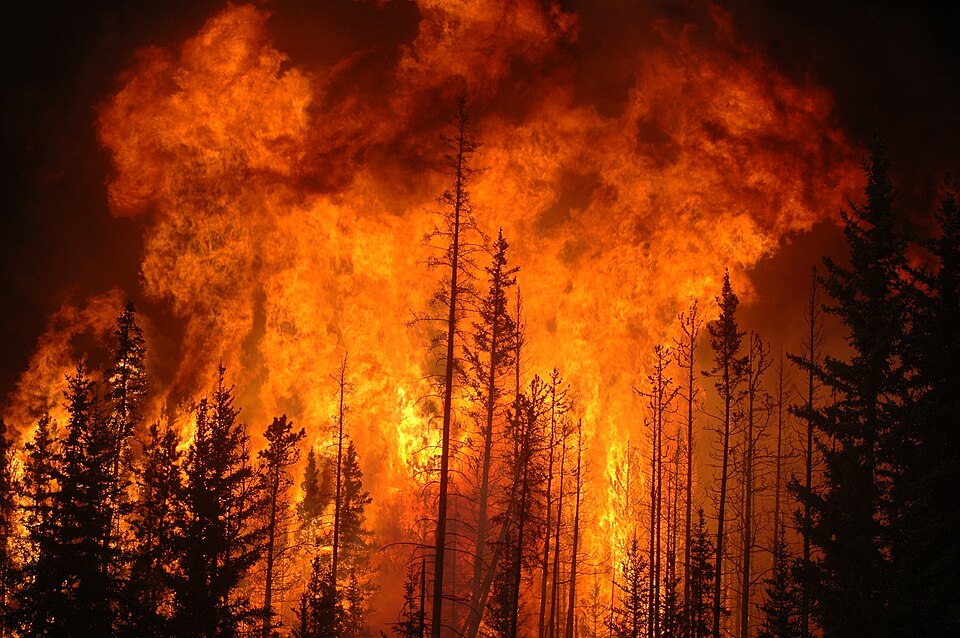
Wildfires are burning across several continents as extreme heat, dry vegetation and lightning drive major emergencies from southwestern Europe to the northern forests of Canada, Russia and the United States.
Europe is approaching the record-setting pace of its 2025 wildfire season. Canada’s fires expanded rapidly after a comparatively slow start. The United States has reached its highest national preparedness level, while large fires in Siberia are sending smoke toward the Arctic.
Viewed from those regions, 2026 looks exceptionally severe.
Globally, the answer is more complicated. Satellite estimates show that carbon emissions from all vegetation fires—including wildfires, agricultural burning and savanna fires—were at their lowest level in the available record during the first six months of the year.
The apparent contradiction reveals an important change in the world’s fire regime: routine burning is declining across parts of Africa and Asia, while the forest fires that threaten communities, produce dense smoke and dominate international news are becoming more extreme in some of the world’s fastest-warming regions.
Where are the major wildfires burning now?
Europe
Europe is experiencing the most acute wildfire emergency.
As of July 22, fires had burned approximately 254,388 hectares in the European Union, according to the European Forest Fire Information System. That was slightly below the 270,449 hectares burned by the same date in 2025—the EU’s worst year on record—but remained above the long-term average.
EFFIS had detected 1,254 fires of at least 30 hectares, more than twice the 20-year average of 569 by that point in the season.
The figures do not yet fully capture fires that intensified after July 22.
Spain has experienced what the Associated Press described as the country’s largest recorded wildfire, exceeding 500 square kilometres. Large fires have also affected France, Italy, Greece, Croatia and other parts of southern and western Europe.
In southwestern France, a massive fire expanded across the Gironde and Landes regions during peak tourism season. France mobilized thousands of firefighters and additional personnel as evacuations spread through communities and vacation areas.
Two firefighters were reported killed while battling a fire in the Rethymno region of Crete, Greece. Aircraft and helicopters were deployed as crews confronted shifting winds and extreme heat.
The fire danger is not confined to the Mediterranean. Significant fires or elevated risk have been recorded in the United Kingdom, the Netherlands, Germany and parts of Scandinavia—regions not traditionally associated with sustained summer fire conditions on the scale seen farther south.
EFFIS forecasts for July 29 through August 5 show “very extreme” conditions across portions of France, the Alpine region, northern Italy, Britain and Ireland, with extreme danger extending across much of the Iberian Peninsula, the Balkans and parts of North Africa.
Above-average temperatures and below-average rainfall are expected across substantial parts of Europe into early August.
Canada
Canada entered the summer below recent fire-season averages before activity accelerated sharply in late June and July.
On July 9, the federal government reported 796 active fires, including 60 classified as out of control under a full-response strategy. At that point, approximately 1.4 million hectares had burned—well below the 4.6 million hectares recorded at the same time in 2025.
The situation subsequently worsened, particularly in Ontario and central Canada. By July 20, Ontario alone had approximately 190 active fires and 735,000 hectares burned, according to provincial figures reported by Reuters. Roughly 1,800 people had been evacuated, many from remote northern and First Nations communities.
Smoke from central Canadian fires travelled through eastern Canada and large portions of the United States before moving over the Atlantic. NASA satellite analysis tracked long-range smoke transport between July 14 and 20.
The national picture nevertheless remains well below Canada’s catastrophic 2023 season, when approximately 18.5 million hectares burned. It is also uneven: western Canada began July with comparatively moderate danger after substantial precipitation, while northern Manitoba, northwestern Ontario, the Northwest Territories and areas around Hudson Bay faced much higher risk.
Canada’s official July outlook warned of above-average temperatures across much of the country through August, with persistent dryness in Manitoba and northwestern Ontario. Southern interior British Columbia was expected to face increasing risk in August. The latest federal statistics and outlook are available through Public Safety Canada.
United States
The United States is running above average in both fire numbers and area burned.
As of July 29, the National Interagency Fire Center reported:
- 43,145 fires since the start of the year;
- More than 4.5 million acres burned;
- 84 active large fires;
- More than 26,000 firefighters and support personnel deployed; and
- Approximately 2.63 million acres involved in fires that remained active.
Both the number of fires and the area burned exceeded the 10-year average.
The Northwest was the principal national pressure point. Oregon had 31 large fires and Washington had 13, with 45 large fires uncontained across the Northwest geographic area.
The United States was operating at National Preparedness Level 5, the highest level, indicating that national firefighting resources were heavily committed and the potential existed for competition between major incidents.
Fire-management personnel from Australia and New Zealand were assisting. Aircraft operated by the U.S. military were also supporting suppression efforts.
Hot, dry conditions and low humidity continued across much of the West, while dry thunderstorms threatened to generate new lightning ignitions across parts of Idaho, Utah, Wyoming and Montana. Texas and Oklahoma also faced dangerous fire environments associated with extreme heat.
Russia and the Arctic
Wildfires began in Russia’s Far East in May before larger fires developed across subarctic Siberia, particularly in Krasnoyarsk Krai.
Satellite monitoring by the Copernicus Atmosphere Monitoring Service detected large smoke plumes moving toward the Arctic Ocean. By the end of June, estimated fire emissions from Siberia were around the seasonal average, rather than at record levels.
That distinction does not mean the fires were minor. Remote boreal fires can burn across enormous areas with limited direct effect on populated communities, making them less visible in international reporting. They can also release substantial carbon from trees and soils and deposit soot on Arctic snow and ice.
Wildfires were also detected in Greenland during June—another sign of how warm, dry conditions can support fire in northern landscapes with historically limited seasons.
Australia and South America
Australia’s principal 2025–26 southern fire season has passed, but it included severe fires in Victoria during January.
The Longwood fire burned more than 136,000 hectares and killed at least one person, while the Walwa–River Road fire burned more than 120,000 hectares. More than 400,000 hectares may have burned across Victoria during the season, according to material submitted to the state’s bushfire inquiry.
South America also experienced damaging fires early in 2026, particularly in Chile’s Biobío region and Argentina’s Chubut province.
The immediate concern is now shifting toward the second half of the year. Developing El Niño conditions are expected to increase drought and heat risks in parts of Central America, the Caribbean and northern South America, potentially raising fire danger in the Amazon basin.
Governments across Latin America have begun activating contingency plans and positioning firefighting resources. The Pan American Health Organization warns that El Niño may contribute to wildfire smoke, respiratory illness, displacement and disruption to health services.
Is the 2026 wildfire season worse than previous years?
There is no honest single yes-or-no answer.
In Europe: close to record territory
Europe’s 2026 burned area was slightly below 2025 at the latest comparable date, but the number of significant fires was more than twice the long-term average.
Because the season remains active, 2026 could still approach or exceed last year’s record. Extreme conditions forecast across western and central Europe mean the final ranking cannot yet be determined.
The more defensible conclusion is that Europe is experiencing another exceptionally severe season immediately after its worst recorded year.
In the United States: clearly above the recent average
The United States has exceeded its 10-year averages for both fire count and acres burned. Its highest preparedness level and the deployment of international assistance demonstrate significant operational pressure.
That does not automatically make 2026 the worst U.S. season on record. But it is worse than a typical recent year to this point.
In Canada: severe, but not another 2023 so far
Canada has hundreds of active fires, widespread smoke and significant evacuations. The season intensified rapidly in July and could remain dangerous through August.
It is nevertheless far below the extraordinary 2023 season and, at the federal government’s July briefing, remained below the five-year average in total seasonal activity.
Canada’s 2026 season is therefore serious and locally extreme, particularly in Ontario and parts of the North, but not nationally unprecedented so far.
Globally: emissions reached a record low through June
Copernicus estimated that fires released just under 400 million tonnes of carbon worldwide between January 1 and June 30—the lowest first-half total in its satellite-based dataset extending back to 2003.
According to the Copernicus Atmosphere Monitoring Service, Africa contributed approximately 154 million tonnes and Asia 113 million tonnes. Together, those continents normally dominate the global total.
Declines in African and Asian burning pulled the worldwide figure downward even as North American and European fire activity increased.
That means 2026 was not the worst global fire year through June when measured by biomass-burning carbon emissions. It was the lowest.
But carbon emissions are only one measurement. They do not capture every aspect of harm.
A remote grass fire, a peat fire and a fast-moving forest fire near a city produce different quantities of emissions and radically different consequences. Total hectares burned, structures destroyed, people evacuated, ecosystem damage and smoke exposure can all tell different stories.
Why can global burning decline while extreme wildfires increase?
Africa accounts for an outsized share of the world’s annual burned area and fire emissions because vast savanna and grassland regions have traditionally burned during dry seasons.
Those fires are often frequent and relatively low-intensity compared with catastrophic forest fires. Changes in farming, grazing, population distribution, roads and fire management have divided landscapes and reduced the spread of savanna fires.
Agricultural burning has also decreased in parts of Asia, while Amazon fire activity was comparatively low entering 2026.
Because Africa and Asia normally produce more than three-quarters of global vegetation-fire emissions, reductions there can outweigh increases across North America and Europe in the global total.
At the same time, climate change is making extreme fire weather more likely in temperate and boreal forests.
The result is fewer emissions from routine vegetation burning globally, but a growing risk of destructive forest fires in particular regions.
What is driving the most destructive fires?
Fire requires an ignition, burnable vegetation and weather that permits flames to spread. Climate change affects the last two parts of that equation.
Higher temperatures
Hot air increases evaporation and draws moisture from vegetation and soil. Grasses, fallen branches and forest litter become easier to ignite and burn more rapidly.
Drier vegetation
A wet spring can promote abundant grass growth. If followed by extreme summer heat, that growth cures into a continuous layer of fuel capable of carrying flames quickly across the landscape.
Longer droughts can dry heavier forest fuels and soils, allowing fires to burn more intensely and for longer periods.
Warmer nights
Firefighters have traditionally benefited from lower temperatures and higher humidity overnight. Warmer, drier nights allow fires to remain active, reducing opportunities to establish control lines or safely attack the perimeter.
Longer seasons
Warming is lengthening the period when large fires can occur, especially in northern forests. Fire activity now begins earlier or continues later in some regions that once had relatively short windows of dangerous conditions.
Lightning and human ignition
Many of Canada’s northern fires were started by lightning. In more populated areas, human activity remains a major source of ignition through equipment, power infrastructure, vehicles, campfires or deliberate burning.
Climate change generally does not provide the spark. It makes the landscape more receptive when a spark arrives.
Fuel accumulation and land management
Decades of aggressive suppression have prevented many smaller fires from removing underbrush and young vegetation in parts of North America. The resulting fuel accumulation can contribute to more intense fires when burning eventually occurs.
Prescribed fire, Indigenous cultural burning, mechanical thinning and defensible space around buildings can reduce some risk. They cannot eliminate fire during the most extreme weather.
El Niño could change the global picture
A developing El Niño is the largest uncertainty for the remainder of 2026.
El Niño rearranges rainfall and atmospheric circulation around the world. Its effects vary significantly by region and season.
It can increase dryness and fire activity in the Amazon, Southeast Asia and the western Pacific. Indonesia experienced severe fire and haze episodes during previous El Niño years, including 2015 and 2019.
In parts of the American West, El Niño can eventually bring additional precipitation. That may reduce short-term forest-fire danger but can also produce greater grass growth, creating fuel for a later season.
Copernicus warned that the second half of 2026 could erase some of the unusually low global emissions recorded during the first half if tropical fire activity accelerates.
The clearest conclusion
The world is not experiencing its worst overall wildfire year on record—at least not by the most comprehensive global emissions measurement available through June.
It is experiencing something more geographically uneven.
Routine fire is declining across landscapes that dominate the global total. At the same time, extreme wildfires are becoming larger, faster or harder to control across parts of Europe and North America, where they threaten more people, infrastructure and property.
Europe is near record territory. The United States is above average. Canada has suffered a major mid-season escalation but remains well below 2023. Siberian fires continue to affect the Arctic, while El Niño could shift the greatest danger toward tropical regions later this year.
The global total may look better. For communities facing evacuation orders, smoke warnings and advancing flames, the local reality is getting worse.