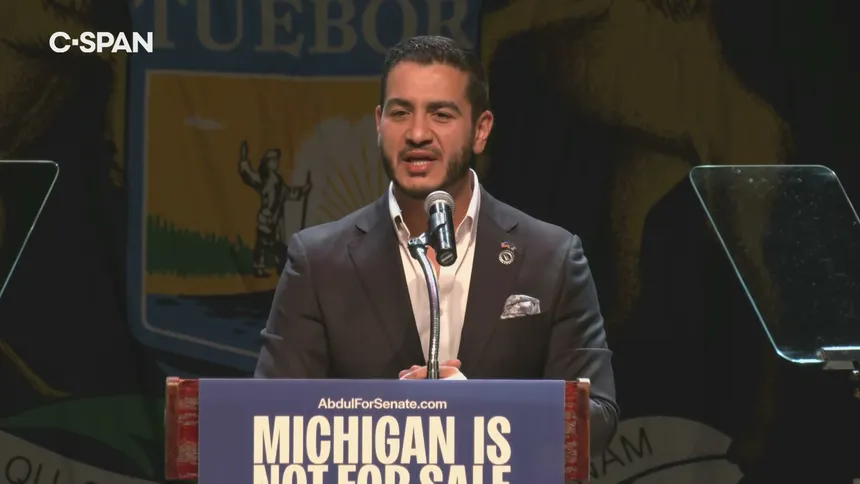
DETROIT — Abdul El-Sayed has won Michigan’s Democratic nomination for the U.S. Senate, overcoming a vast outside-spending disadvantage and defeating four-term congresswoman Haley Stevens in one of the most closely watched primaries of the 2026 midterm campaign.
The Associated Press called the race Wednesday morning after additional returns from Wayne and Oakland counties left Stevens without enough outstanding votes to overtake El-Sayed. With most ballots counted, El-Sayed had approximately 48.5 per cent of the vote to Stevens’ 47.5 per cent. State Sen. Mallory McMorrow, who suspended her campaign before election day but remained on the ballot, received the balance.
El-Sayed will face former Republican congressman Mike Rogers in November for the seat being vacated by retiring Democratic Sen. Gary Peters. Rogers was unopposed for the Republican nomination.
The general election is expected to be one of the country’s most competitive Senate contests and could help determine which party controls the chamber during the final two years of President Donald Trump’s term.
El-Sayed’s victory was important beyond Michigan. It demonstrated that a candidate running on Medicare for All, ending U.S. military assistance to Israel and confronting corporate power could defeat an experienced, well-funded moderate in a state Trump carried in 2024.
It was also a test of three increasingly connected forces on the American left: the movement created by Bernie Sanders’ presidential campaigns, the organizing network surrounding the Democratic Socialists of America and a new political-media ecosystem represented by Twitch streamer Hasan Piker.
Michigan primary results: Who won what?
The most important projected winners from Michigan’s August 4 primary include:
U.S. Senate
Democratic: Abdul El-Sayed defeated U.S. Rep. Haley Stevens. El-Sayed received roughly 48.5 per cent of the vote, with Stevens at approximately 47.5 per cent when the race was called.
Republican: Mike Rogers advanced without a contested primary.
El-Sayed and Rogers will compete for Michigan’s open Senate seat on November 3.
Governor
Democratic: Secretary of State Jocelyn Benson won the Democratic nomination to succeed term-limited Gov. Gretchen Whitmer.
Republican: U.S. Rep. John James won the Republican nomination.
Benson and James will now compete in another nationally significant race in a state that has moved repeatedly between the two parties. Former Detroit mayor Mike Duggan had been running as an independent but suspended his campaign in May.
U.S. House, 7th District
Democratic: Will Lawrence won the nomination in one of the state’s principal congressional battlegrounds.
Lawrence will challenge Republican Rep. Tom Barrett in November. The result was another victory for Michigan’s organized progressive movement, although Lawrence’s coalition and political identity are distinct from El-Sayed’s.
U.S. House, 13th District
Democratic: State Rep. Donavan McKinney defeated incumbent U.S. Rep. Shri Thanedar in the heavily Democratic Detroit-area district.
Because the district strongly favours Democrats, McKinney is positioned to enter Congress if he wins the general election. The upset was particularly notable because primary voters removed a sitting member of Congress in favour of a younger progressive with deep roots in Detroit organizing.
Michigan’s official results are being collected by the Department of State. Results remain unofficial until canvassing and certification are complete.
Other notable August 4 primary results
Michigan produced the night’s biggest national story, but voters also cast ballots in Kansas, Missouri, Virginia and Washington.
In Missouri, Democratic Rep. Wesley Bell defeated former congresswoman Cori Bush in a rematch of their 2024 primary. Bell first removed Bush, a prominent progressive associated with the congressional “Squad,” two years earlier. Conservative broadcaster Chris Stigall won the Republican nomination in Missouri’s strongly Republican 6th Congressional District.
In Virginia, Democrats chose Henrico County prosecutor Shannon Taylor to challenge a Republican incumbent in the 1st District. Former representative Elaine Luria won the Democratic nomination in the 2nd District, setting up a rematch against Republican Rep. Jen Kiggans. Democratic Rep. Don Beyer also won renomination in the safely Democratic 8th District. The Associated Press election review identified Michigan’s progressive shift and Virginia’s preference for more establishment-oriented candidates as two contrasting signals from the same primary night.
Washington uses a top-two system rather than separate party nominations, meaning the two leading candidates in each race advance regardless of party. Some close Washington contests remained subject to additional mail-ballot counting Wednesday.
Who is Abdul El-Sayed?
El-Sayed, 41, is a physician, epidemiologist, author and former public-health administrator.
Born and raised in Michigan, he studied biology and political science at the University of Michigan before attending Oxford University as a Rhodes Scholar. He earned a medical degree from Columbia University and worked as a professor of epidemiology at Columbia.
In 2015, El-Sayed returned to Michigan to lead the Detroit Health Department. The city had recently emerged from bankruptcy and was rebuilding a department that had been significantly reduced. El-Sayed later served from 2023 to 2025 as director of Wayne County’s Department of Health, Human and Veterans Services.
His campaign emphasized that Wayne County work, including an initiative that eliminated approximately $700 million in medical debt affecting an estimated 300,000 residents.
El-Sayed first became a major political figure during the 2018 Democratic primary for Michigan governor. He ran as a Sanders-aligned progressive and earned significant national attention but finished second to Gretchen Whitmer, who went on to win the governorship.
His 2026 Senate campaign was more disciplined and more broadly organized. El-Sayed retained the economic-populist themes of his first statewide run while building support from labour organizations, progressive elected officials, Muslim and Arab-American voters, younger voters and Democrats dissatisfied with the party’s response to Trump.
His principal policies included:
- Establishing a national Medicare for All system;
- Reducing prescription-drug prices and medical debt;
- Banning corporate political-action committee contributions;
- Strengthening unions and labour protections;
- Increasing taxes on billionaires and large corporations;
- Ending U.S. military aid to Israel;
- Investing in housing, education and domestic infrastructure; and
- Taking a more confrontational approach toward the Trump administration.
El-Sayed could become the first Muslim elected to the U.S. Senate if he wins in November. Michigan has one of the country’s largest Arab-American and Muslim populations, but his primary coalition was not limited to those communities. He also performed competitively across portions of western and northern Michigan that progressives will need to contest in the general election.
Why El-Sayed’s victory was significant
The result was not simply another win by a progressive candidate in a safely Democratic district.
Michigan is a genuine battleground. Trump carried it in 2016 and again in 2024, while Democrats won it in 2020. The party cannot afford to treat the Senate race as an ideological experiment without national consequences.
Stevens presented herself as the safer general-election candidate. She had won a competitive suburban House district, worked on former president Barack Obama’s auto-industry task force and accumulated support from much of the Democratic establishment.
El-Sayed argued that the party’s conventional strategy had already failed. He said Democrats had lost working-class voters because they appeared too closely connected to wealthy donors and Washington institutions while failing to address the cost of health care, housing and everyday life.
Primary voters narrowly accepted his argument.
The victory also came despite an enormous spending imbalance. Axios reported that El-Sayed faced an outside-spending disadvantage of approximately 12 to one. More than $60 million in outside spending entered the Senate contest, according to campaign-finance estimates cited by national media.
The American Israel Public Affairs Committee and allied interests reportedly spent roughly $30 million in an unsuccessful effort to defeat him. AIPAC said after the result that it would continue opposing El-Sayed and what it called his “radical anti-Israel agenda.”
That makes the result an important test of whether large independent expenditures can still determine Democratic primaries. They unquestionably shaped the campaign, but they did not prevent El-Sayed from defining the spending itself as evidence of the corporate and foreign-policy influence he was campaigning against.
Israel and Gaza were central to the divide
The primary exposed a major disagreement inside the Democratic Party over Israel.
El-Sayed has called Israel’s military campaign in Gaza a genocide and supports ending American military assistance to the Israeli government. He argued that U.S. resources should be spent on health care, education and infrastructure rather than weapons used overseas.
Stevens remained a strong supporter of the U.S.-Israel relationship and rejected the genocide characterization.
That contrast mattered in Michigan, where anger over the Biden administration’s support for Israel contributed to the 2024 “uncommitted” campaign and weakened Democratic support among Arab-American and Muslim voters.
El-Sayed’s victory does not establish that every Michigan voter supported his foreign-policy position. Health care, affordability, campaign finance and opposition to Trump were central parts of his coalition. But it demonstrates that criticism of Israel and AIPAC was not disqualifying in a statewide Democratic primary.
It may also encourage other candidates to challenge pro-Israel spending organizations more directly instead of attempting to avoid the issue.
Bernie Sanders played more than an endorsement role
Sen. Bernie Sanders was the most important established political figure supporting El-Sayed.
Sanders endorsed him early, appeared in campaign advertising and travelled to Michigan for multiple rallies. He was joined at major events by Rep. Alexandria Ocasio-Cortez, who made El-Sayed her first endorsement in a competitive Senate primary during the cycle.
Sanders’ role was organizational as well as symbolic.
His 2016 presidential campaign demonstrated the viability of financing a national campaign through large numbers of smaller online contributions. His unexpected victory over Hillary Clinton in Michigan that year also showed that an economic-populist candidate could perform beyond the country’s most liberal communities.
El-Sayed’s campaign drew directly from that model: reject corporate PAC money, emphasize individual donors, campaign against economic concentration and argue that left-wing economic policies can reach people who have abandoned the Democratic Party.
Sanders helped reassure progressive voters that El-Sayed was the movement’s candidate while attracting media attention and volunteers. His rallies with El-Sayed and Ocasio-Cortez connected the Michigan campaign to a larger national effort commonly described as the fight between ordinary voters and powerful political or corporate interests.
The result strengthens Sanders’ influence in Democratic primaries even as he approaches the later stages of his Senate career. It also gives his political movement something it has rarely possessed: a credible opportunity to elect an aligned candidate to a competitive, open Senate seat.
What is the Democratic Socialists of America’s role?
The Democratic Socialists of America is the largest socialist organization in the United States. It is not a political party and does not control a separate ballot line nationally. Its members generally compete in Democratic primaries while seeking to move policy and political power to the left.
DSA advocates democratic control over major economic institutions, stronger unions, universal public programs, tenant protections, expanded public ownership and reduced corporate power. Its chapters are locally governed, and positions or endorsements can differ between the national organization and local groups.
The organization grew dramatically after Sanders’ 2016 presidential campaign. Although Sanders is an independent who calls himself a democratic socialist, he is not governed by DSA and frequently has strategic differences with the organization.
El-Sayed was closely associated with the broader Sanders movement, but it would be inaccurate to describe his victory simply as a formal DSA takeover. El-Sayed was not running as a DSA-branded candidate, and he told The Atlantic before the election that party insiders were trying to place that label on him.
The more important DSA story was the surrounding ecosystem.
Michigan progressives won several races Tuesday. A DSA member defeated an incumbent state representative, while candidates associated with the uncommitted movement and the Working Families Party also advanced in legislative contests. Lawrence and McKinney added two prominent congressional victories.
These results suggest that Michigan’s left has developed beyond a single charismatic candidate. It now includes organizers, labour allies, local elected officials, small-donor networks and activists capable of contesting races at several levels.
DSA’s electoral strength remains uneven. Cori Bush’s defeat in Missouri on the same night illustrated the limits of the movement and the difficulty of protecting controversial incumbents. Michigan nevertheless showed that socialist and progressive organizations can help build a coalition large enough to influence statewide politics even when their preferred candidate does not formally campaign under the DSA name.
Hasan Piker brought a different kind of political power
Hasan Piker is a left-wing political commentator whose livestreams reach a large audience on Twitch and other platforms, particularly among younger voters.
Unlike a traditional cable-news host, Piker broadcasts for hours at a time, reacting to news, interviewing political figures and speaking directly with an online audience. That relationship can translate into attention, donations and volunteers for candidates who might otherwise struggle to reach people who do not follow conventional political media.
Piker endorsed El-Sayed and appeared with him at campaign events at the University of Michigan and Michigan State University in April. Rep. Summer Lee also participated. El-Sayed’s campaign said the two campus events attracted more than 1,200 people, with larger audiences watching online.
Piker’s involvement generated significant opposition.
Republicans and centrist Democratic group Third Way highlighted inflammatory statements from his previous broadcasts, particularly a 2019 remark that “America deserved 9/11.” Piker later said the comment was inappropriate and that he regretted the wording, but it has continued to be used against candidates who associate with him.
Critics have also accused Piker of antisemitism over his commentary about Israel and Gaza. Piker rejects that characterization and says his criticism is directed at the Israeli government and Zionism rather than Jewish people.
El-Sayed did not cancel the events. He argued that candidates should engage large audiences even when they do not agree with every statement a supporter or interviewer has made.
That decision became a test of how wide the Democratic coalition should be. Establishment groups argued that Piker would provide Republicans with damaging general-election material. El-Sayed’s supporters argued that rejecting influential left-wing media personalities would isolate the party from younger voters who increasingly receive political information through livestreams, podcasts and social platforms.
Piker did not single-handedly produce El-Sayed’s victory. The candidate had years of statewide recognition, endorsements from Sanders and Ocasio-Cortez, labour support and an extensive field operation. But Piker helped amplify him among younger voters and demonstrated that online creators can now occupy a role once reserved for party-aligned television networks, radio hosts and newspaper editorial boards.
Republicans have already signalled that Piker will feature in their general-election attacks. Rogers criticized El-Sayed for campaigning with him immediately after the primary.
What happens in November?
El-Sayed now faces a substantially different electorate.
A Democratic primary rewards ideological enthusiasm and party activists. The general election will include Republicans, independents and voters who supported Trump in 2024 but may not identify consistently with either party.
Rogers will attempt to portray El-Sayed as too far left for Michigan, focusing on socialism, Israel, immigration, Sanders and Piker. Vice-President JD Vance and Trump have already attacked El-Sayed personally, while AIPAC has promised to continue spending against him.
El-Sayed will argue that his economic platform can win back voters who feel abandoned by both parties. In his victory speech, he invited people who voted for Trump in 2024 to join his campaign, emphasizing affordability and health care rather than presenting the election solely as a contest between left and right.
Stevens has conceded and said she is “proud to offer” El-Sayed her support. Democratic Senate leaders also moved quickly to back the nominee, reflecting how essential Michigan is to their strategy for gaining control of the chamber.
The primary established that El-Sayed can assemble a winning Democratic coalition while being massively outspent. It did not answer whether that coalition can survive months of national Republican attacks in a state divided almost evenly between the parties.
That is what makes his victory consequential. Michigan Democrats did not merely nominate a new candidate. They chose a theory of how their party should respond to Trump, corporate power and its own losses among working-class voters.
In November, that theory will be tested statewide.