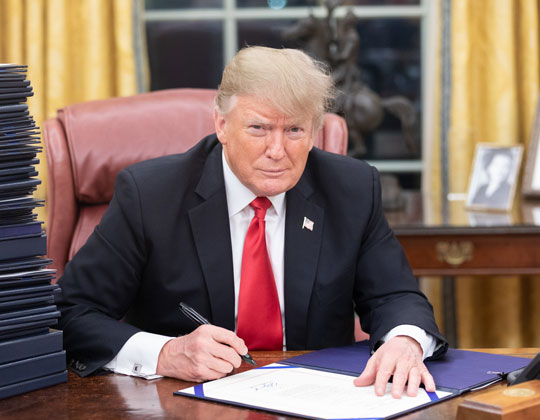
WASHINGTON—President Donald Trump has ordered the installation of temporary warning signs outside the Smithsonian’s National Museum of American History, escalating a dispute over who should control the way the United States presents its past.
The executive order, signed July 24, directs the Department of the Interior and National Park Service to place signs along sidewalks and walkways used by visitors approaching the museum in Washington.
Those signs are expected to tell visitors that museum exhibits should be revised in response to a recent White House report accusing the Smithsonian of “ideological capture.” They will also direct visitors to administration-approved sources that Trump says provide accurate information about American history.
The order additionally calls for temporary outdoor exhibits or signs honouring the 56 signers of the Declaration of Independence and “correcting” information the administration considers inaccurate inside the museum.
However, the order does not identify the exact wording of the signs, specify when they must appear or list the individual museum statements the outdoor displays will supposedly correct.
It also does not order the Smithsonian to install them.
That distinction is central to understanding the story.
Trump has direct authority over the Department of the Interior and National Park Service. He does not exercise the same direct control over the Smithsonian, which was created by Congress and is overseen by an independent Board of Regents.
The administration is therefore using federally managed sidewalks outside the museum to deliver a political rebuttal to the exhibitions inside it.
What Trump’s order actually requires
The executive order published by the White House contains three principal directives.
First, it instructs the Interior secretary, Office of Management and Budget director, General Services Administration and White House Domestic Policy Council to identify “any and all available authorities” that could encourage the Smithsonian to comply with the administration’s preferred approach.
That language could include federal funding, contracts, building arrangements and other administrative leverage. The order does not immediately cancel funding or rewrite any museum displays.
Second, it orders the National Park Service to install temporary signs on its sidewalks and walkways outside the National Museum of American History. The signs are to summarize the findings of the administration’s report and tell visitors that exhibits should be renovated.
Third, it calls for temporary exhibits or signs on Park Service land that honour the Declaration’s 56 signers and correct what the order calls inaccurate museum information.
The order repeatedly describes the museum’s interpretation as inaccurate, but it does not supply a list of provably false labels. Nor does it establish an independent panel of historians to evaluate disputed facts.
It instead adopts the findings of a report produced by Trump’s Domestic Policy Council—an office within the White House.
Smithsonian officials had not publicly announced a legal challenge or detailed response as of publication. The institution declined to comment immediately after the order was released, according to The Associated Press.
The 162-page report behind the warning signs
The order is based on a July 4 White House report titled Saving America’s Story: How Ideological Capture at the Smithsonian Institution’s National Museum of American History Erases Our Heritage.
Across 162 pages, the report argues that museum leaders have moved away from traditional historical education and toward social activism. It criticizes exhibits dealing with race, slavery, immigration, gender identity, LGBTQ history and inequality.
It also argues that the museum does not sufficiently celebrate the country’s founders, military achievements, flag, national identity or constitutional government.
The full White House report contains extensive citations and screenshots. Its length and footnotes give it the appearance of a historical audit, but many of its conclusions concern tone, emphasis and interpretation rather than demonstrably incorrect facts.
That difference is important.
For example, the report criticizes a museum display noting the “tragic irony” between the Declaration of Independence’s assertion that all men are created equal and the continued existence of slavery.
The report calls that framing divisive and argues that the exhibit reduces the abolition of slavery to a racial lens. It does not show that the underlying historical information is false.
The contradiction between the Declaration’s language and slavery is a documented historical reality. Several prominent founders enslaved people. Enslaved and free Black Americans played major roles in the abolitionist movement, while abolition also drew support from Americans of other backgrounds.
A disagreement about how prominently a museum should present that contradiction is not the same thing as discovering a factual error.
The White House report also criticizes the museum for describing the familiar story of the Pilgrims at Plymouth as part of America’s “mythic past.” Again, the dispute is largely interpretive: whether museums should present celebrated national stories primarily as inspirational narratives or examine how those stories were constructed and simplified over time.
Does the museum ignore America’s founding?
The administration’s most politically effective charge may also be its most complicated.
The White House report says the museum has failed to produce a general narrative of American history or an exhibit devoted to the founders, Declaration of Independence, Revolutionary War and establishment of constitutional government.
Museum director Anthea Hartig disputes that characterization.
In May, the museum opened In Pursuit of Life, Liberty and Happiness, a 250-object exhibition distributed throughout the building for the country’s 250th anniversary. Its artifacts include the portable desk Thomas Jefferson used while drafting the Declaration, a Revolutionary War gunboat and the original Star-Spangled Banner.
During a congressional hearing, Republican Rep. Michael Cloud acknowledged that material about the Declaration was present but said it was difficult for visitors to find.
That may represent a legitimate exhibition-design criticism. A museum can possess important objects yet present them in a layout that visitors find confusing or insufficiently prominent.
It is different, however, from saying the museum erased the founding entirely.
The Associated Press’ account of Hartig’s testimony shows the dispute more accurately: the White House says founding history has been displaced, while museum leaders say it is being presented alongside people and evidence earlier national narratives left out.
What will the signs say?
The final language has not been released.
The executive order requires signs explaining the White House report’s findings and directing visitors to administration-approved resources. It does not specifically require the more inflammatory phrase proposed in the report itself:
“Warning: the exhibits in this museum were prepared by people who don’t want you to love your country.”
The report recommends language to that effect above museum entrances, but the executive order does not reproduce it as mandatory text.
That leaves the Interior Department considerable discretion. Its signs could range from a brief notice linking to the White House report to a direct accusation that museum staff are misleading the public.
The distinction will matter legally and politically.
A notice stating that the administration disputes the museum’s interpretation would clearly identify a political disagreement. A government sign presenting that disagreement as a settled finding of historical inaccuracy would carry a much stronger—and less substantiated—claim.
The order describes the signs as temporary but provides no removal date.
Why Trump cannot simply order the museum to change its exhibits
The Smithsonian occupies an unusual place in American government.
Congress created it in 1846 as a public trust “for the increase and diffusion of knowledge.” It receives substantial federal funding, but it is not an ordinary executive department controlled by the president.
The institution is governed by a 17-member Board of Regents consisting of:
- The chief justice of the United States
- The vice-president
- Three senators
- Three members of the House of Representatives
- Nine citizen members
The board appoints the Smithsonian secretary, who oversees the museums and their directors. The president is not a member of the board.
The Congressional Research Service describes the Smithsonian as governmental but organizationally separate from the executive, legislative and judicial branches. Courts have also found that it is not an executive agency for the purposes of laws including the Freedom of Information Act, Administrative Procedure Act and Privacy Act.
The Smithsonian’s own legal history explains that its unusual status has produced different answers under different federal statutes. In one context, the Justice Department has treated it as an executive agency; in others, courts have held that it is not.
But the basic governance point is clear: Trump cannot treat a Smithsonian museum director like a cabinet official and dismiss that person at will.
That is why the latest order focuses on the National Park Service property surrounding the museum.
The Park Service is part of the Interior Department. Its sidewalks provide the administration with a physical platform from which it can criticize an institution it cannot immediately command.
Could the order be challenged?
The sidewalk directive is likely more legally durable than a direct presidential takeover of Smithsonian exhibits.
The federal government generally has broad authority to communicate its own message on government-managed property. A sign installed by the Park Service would likely be considered government speech, rather than a restriction imposed on a private speaker.
However, several questions remain unanswered:
- Whether the signs interfere with Smithsonian-controlled entrances or operations
- What funding Congress has authorized for the project
- Whether the administration attempts to condition already appropriated Smithsonian funds on ideological compliance
- Whether specific signage falsely implies the Smithsonian endorses the administration’s message
- Whether future directives intrude upon authority Congress assigned to the Board of Regents
The executive order includes conventional language saying it must be implemented consistently with existing law and subject to available appropriations.
The more significant conflict may therefore concern funding rather than the signs themselves.
The Smithsonian receives more than $1 billion annually from the federal government, with private donations and commercial revenue providing additional support. Congress can attach lawful conditions to appropriations, conduct oversight and change the institution’s governing statutes.
A president cannot unilaterally exercise all of those congressional powers. But the White House and allied lawmakers can use budgets and hearings to place intense pressure on Smithsonian leadership.
The Smithsonian’s response
Hartig told lawmakers that the museum does not take sides in political disputes and said its evolving historical approach is intended to add evidence and voices, not erase earlier history.
“When historians talk about reframing a traditional narrative, we don’t mean erasing it,” she testified. “We mean adding the evidence, the voices, the objects, that earlier tellings left out, so that more Americans can see themselves reflected in the national story.”
She acknowledged that museums can improve, but said the White House report did not fairly or accurately characterize the institution’s full work.
The Smithsonian’s Board of Regents has attempted to defend institutional independence without dismissing concerns about political neutrality. In a previous statement on governance, the board affirmed Secretary Lonnie Bunch’s authority while directing him to establish expectations for unbiased museum content and report on any required changes.
That was a carefully balanced response. It maintained that personnel and exhibition decisions belong to Smithsonian leadership while recognizing that a publicly funded institution must be prepared to defend its scholarship and presentation.
Professional historical organizations have been less restrained.
The American Historical Association said the Smithsonian is committed to scholarship and accuracy and argued that patriotism can include both pride in American achievements and criticism of national failures. Its statement defending the Smithsonian rejects the idea that examining inequality is inherently anti-American.
The National Council on Public History described the White House report as an effort to simplify and politically control a complex historical record.
Those organizations are not politically neutral arbiters in the eyes of the administration. They represent the professional field whose methods Trump’s advisers are challenging. Their opposition nevertheless shows that the report has not produced a broad scholarly consensus that the museum’s central historical claims are false.
The strongest argument for Trump’s intervention
The administration’s case should not be reduced to the idea that museums must never face political scrutiny.
The Smithsonian receives public money, occupies prominent national space and exercises enormous influence over which stories are preserved and displayed. Curators make subjective choices about what to include, what to omit and which themes connect historical objects.
Those choices can contain political assumptions even when presented as neutral scholarship.
A national museum also has a dual role. It is expected to educate visitors critically, but it is also a site of collective memory and national commemoration. The 250th anniversary provides a reasonable basis for asking whether the founding, Revolution and Constitution are sufficiently prominent and accessible.
The museum should be able to answer those questions clearly.
But accountability is not the same as requiring museums to adopt the president’s preferred emotional conclusion about history. An exhibit does not become inaccurate merely because it leaves visitors troubled, and it does not become accurate merely because it leaves them proud.
The deeper conflict: history or national memory?
The dispute reveals two fundamentally different views of what a national museum is for.
The Trump administration describes history as a shared inheritance that should inspire gratitude, unity and confidence. It argues that focusing heavily on injustice teaches Americans to see their country as fundamentally oppressive.
Museum leaders and many professional historians view history as an evidence-based inquiry that must include conflict, contradiction and experiences excluded from older national narratives. Under that approach, slavery, racial exclusion and unequal citizenship are not side issues added to disparage the country. They are necessary to understanding how American institutions developed and changed.
Both approaches involve choices.
A purely celebratory museum can become propaganda by omitting evidence that complicates national myths. A museum that presents only oppression and failure can also distort history by neglecting achievement, reform and democratic resilience.
The professional task is to establish proportion through evidence. Trump’s executive order instead places the White House in the position of publicly labeling one interpretation inaccurate before it has identified a catalogue of specific factual errors.
Political pressure at the Smithsonian is not new
The Smithsonian has faced political intervention before.
In the 1990s, the National Air and Space Museum planned an exhibition around the Enola Gay, the aircraft that dropped the atomic bomb on Hiroshima. Veterans’ groups and lawmakers argued that the proposed script was overly sympathetic to Japan and unfair to Americans who fought in the Second World War.
After threats to Smithsonian funding and months of political pressure, the larger exhibition was cancelled. A narrower display focused on the aircraft replaced it, and museum director Martin Harwit resigned.
The Smithsonian’s own historical account describes the episode as a continuing case study in how museums present contested history. The institution’s Enola Gay history notes that the national controversy produced the cancellation in early 1995.
The current dispute is different in form but familiar in substance: elected officials accuse professional curators of presenting the country unfairly, while historians warn that political pressure will remove necessary context.
What is unusual now is the president’s decision to build a competing government interpretation immediately outside the museum.
What happens next
The Interior Department and National Park Service must now draft and install the temporary signs. The order contains no public deadline, and it remains unknown how extensive the outdoor exhibits will be.
Several developments will determine whether the action remains symbolic or becomes a larger institutional confrontation:
- The wording and placement of the signs
- Whether the Smithsonian publishes a point-by-point response
- Whether the Board of Regents formally intervenes
- Whether Congress attaches new conditions to Smithsonian funding
- Whether museum exhibits or personnel change under pressure
- Whether the order produces litigation
For the moment, Trump has not taken control of the Smithsonian.
He has done something more strategically limited: use property he controls to discredit the historical authority of the museum he does not.
The signs may be temporary. The precedent could last considerably longer.