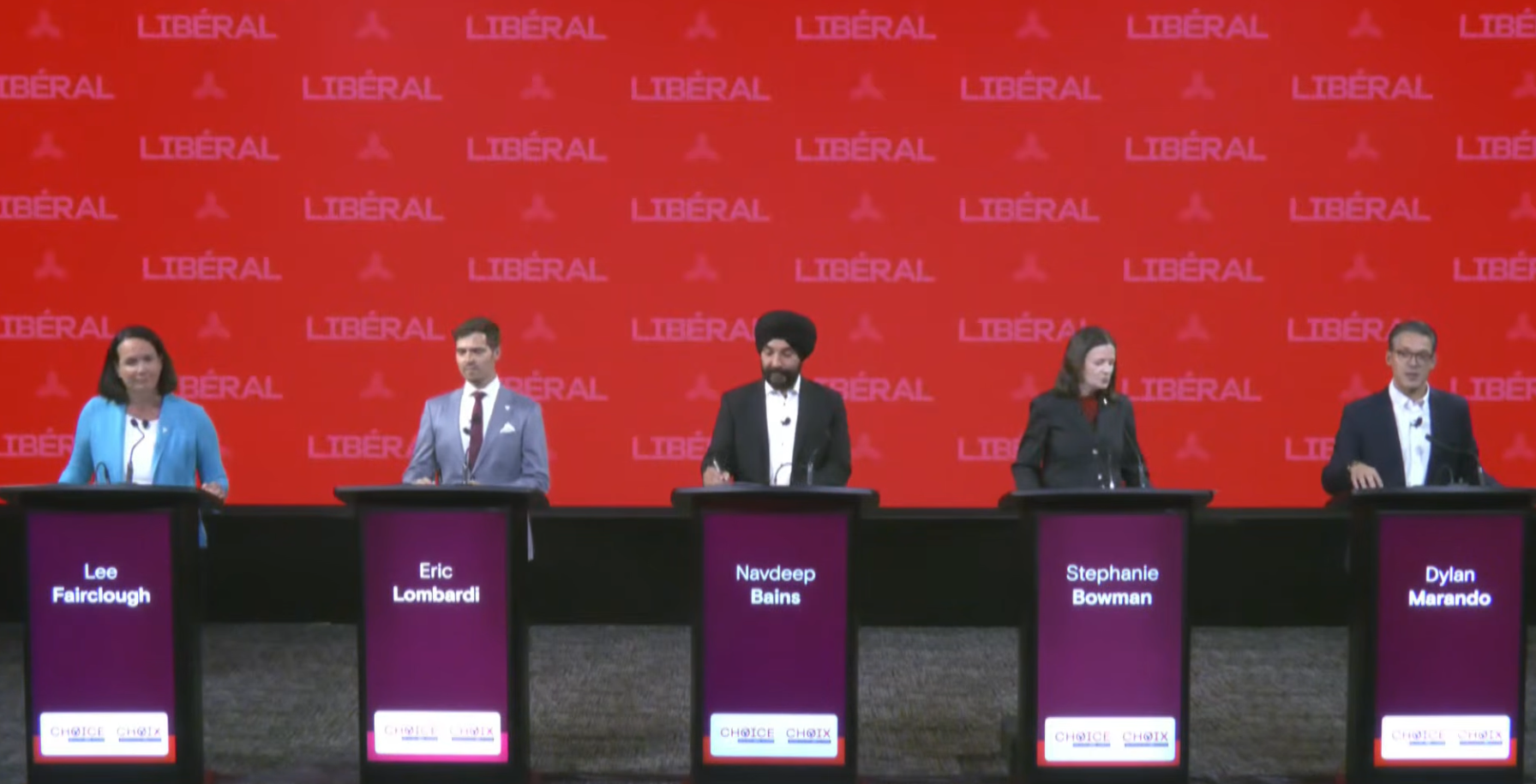
The five candidates seeking to lead the Ontario Liberal Party used their first official debate to promise a stronger public health-care system, renewed education funding and relief from Ontario’s affordability crisis—but some of the most important disagreements concerned the party itself.
Should the next leader already hold a seat at Queen’s Park? Should Ontario Liberals position themselves on the centre-left, compete for disaffected Progressive Conservative voters or reject conventional ideological labels? Would private health-care providers have any place in a Liberal-led system? And after three consecutive election defeats, can the party afford to choose another leader without a clear path into the legislature?
Those questions animated the approximately 100-minute debate on August 10, moderated by The Trillium reporter Tina Yazdani. The participants were former federal cabinet minister Navdeep Bains, Don Valley West MPP Stephanie Bowman, Etobicoke–Lakeshore MPP Lee Fairclough, housing advocate Eric Lombardi and former political adviser Dylan Marando.
The debate produced relatively few direct attacks between candidates. Instead, all five concentrated their fire on Premier Doug Ford and attempted to explain why they could rebuild a Liberal party that has changed leaders repeatedly without defeating him.
That restraint kept the event civil, but it also left some policy differences only partially explored. Candidates frequently agreed on the nature of Ontario’s problems while offering different levels of detail about costs, implementation and trade-offs.
The complete debate can be watched below, courtesy of Ontario Liberal TV.
Who is running for Ontario Liberal leader?
Navdeep Bains
Bains is the best-known candidate nationally. He served as a federal Liberal MP for 13 years and was minister of innovation, science and economic development in Justin Trudeau’s government.
Born in Toronto and raised in Brampton, Bains worked as a financial analyst before entering politics. He left federal office in 2021 and has since worked in the private sector and academia.
His campaign is built around experience, economic credibility and electability. Bains repeatedly reminded viewers that he has won five elections and held a senior economic portfolio in Ottawa.
Stephanie Bowman
Bowman has represented Don Valley West at Queen’s Park since 2022. A chartered professional accountant, she previously worked as a partner at Ernst & Young, a senior vice-president at Scotiabank and a member of the Bank of Canada’s board of directors.
Her leadership pitch emphasizes financial discipline, party organization and her ability to challenge Ford from inside the legislature. Bowman has proposed middle-income and small-business tax reductions as well as a youth employment program.
Lee Fairclough
Fairclough was elected MPP for Etobicoke–Lakeshore after previously running unsuccessfully in 2022. Before entering provincial politics, she held senior positions in Ontario’s health-care system, including serving as president of St. Mary’s General Hospital in Kitchener.
She is also a former member of Canada’s national women’s rugby team. Fairclough has made health care, government accountability and rebuilding the Liberals from the constituency level central to her campaign.
Eric Lombardi
Lombardi is a finance and technology entrepreneur and the founder of More Neighbours Toronto, a housing advocacy organization that supports zoning reform and increased construction.
A University of Waterloo nanotechnology engineering graduate, he is running as a policy-focused outsider. Lombardi argues that Ontario needs structural reforms to housing, health care, education and government rather than another collection of short-term subsidies.
Of the five candidates, he most clearly positioned himself as willing to use market-based solutions and appeal directly to voters who previously supported the Progressive Conservatives.
Dylan Marando
Marando is a former political staffer who has worked in the Prime Minister’s Office, the Ontario premier’s office and the private sector. He holds a doctorate in political science and teaches at the University of Toronto’s Munk School of Global Affairs and Public Policy.
His campaign presents him as a generational-change candidate: younger than his principal rivals, experienced behind the scenes but not associated with the party’s recent electoral defeats. Marando used the debate to call for higher public-sector wages, broader public services and a more assertive alternative to Ford.
Biographical information for all five contenders is available on the party’s official candidate page.
A debate aimed more at Ford than at one another
The central political message was remarkably consistent: the candidates believe Ford has become disconnected from the financial pressures facing ordinary Ontarians.
Fairclough attacked the government over its proposed provincial aircraft, the Highway 401 tunnel concept, spending at Ontario Place and recent expense controversies. Marando accused Ford of caring more about political insiders and luxury expenses than affordability. Bains repeatedly described the government’s economic record as a failure, pointing to youth unemployment and weak growth.
Bowman emphasized what she characterized as wasteful spending on private nursing agencies and the Skills Development Fund. Lombardi argued that the government had failed to confront the deeper structural problems constraining housing construction, productivity and economic growth.
The candidates rarely turned those criticisms on each other.
That was almost certainly deliberate. Ontario Liberals are still recovering from the internal instability that followed their 2018 collapse. Former leader Bonnie Crombie resigned in January after receiving only 57 per cent support in a mandatory leadership review. John Fraser has served as interim leader during the contest. Crombie’s resignation took effect January 14.
The first debate suggested none of the candidates wants to deepen those divisions unnecessarily. Fairclough and Bowman both said the entire group should remain involved after the contest, with Bowman urging her rivals to run in the next provincial election.
The first major divide: does the leader need a seat?
Fairclough and Bowman argued that recent Liberal experience has demonstrated the importance of having a leader in the legislature.
Neither Steven Del Duca nor Crombie held a Queen’s Park seat during the general elections they led. Both struggled to secure consistent media attention and establish themselves as daily opponents of Ford.
Bowman said being in the legislature allows a leader to challenge the government, advance policy proposals and attract regular public attention. Fairclough argued that a sitting MPP gains direct knowledge of legislation and can connect issues heard across Ontario to the government’s conduct inside Queen’s Park.
That argument clearly favours the two sitting MPPs.
Marando rejected it. He said voters in the next election would care more about whether a leader could improve schools, health care and employment than whether the leader already had a legislative seat.
He also challenged the party’s preferred explanation for its recent defeats. Del Duca had previously been an MPP and cabinet minister, while Crombie had experience as a federal MP and mayor of Mississauga. In Marando’s assessment, the party’s failures resulted from an inadequate plan and voters’ doubts about its readiness to govern—not simply the leaders’ absence from Queen’s Park.
Lombardi similarly argued that a compelling leader could still hold news conferences at the legislature and command attention without being an MPP.
Bains, who also lacks a provincial seat, emphasized his electoral record rather than directly accepting the premise that legislative membership is essential.
The exchange exposed one of the clearest choices in the contest. Bowman and Fairclough offer an immediate parliamentary presence. Bains, Lombardi and Marando are asking members to accept the risk of once again choosing a leader who would initially operate outside the legislature.
Affordability: immediate relief or structural reform?
Asked for the single most important action they would take during their first year as premier, the candidates agreed that affordability is urgent but disagreed about the most effective response.
Marando called for higher wages, a middle-class tax reduction and cheaper public services. He specifically identified wages for personal support workers, developmental-service workers, early childhood educators and educational assistants. He also proposed reducing child-care costs and making comprehensive mental-health treatment part of OHIP.
His argument was that housing construction and productivity reforms could take years to affect household budgets. Immediate tax, wage and service measures, he said, could provide relief much sooner.
Bains focused initially on grocery prices. He proposed stronger consumer protection against surveillance-based or personalized pricing, more Ontario food production and changes intended to increase competition in the grocery sector, including scrutiny of lease and property arrangements that can restrict competitors.
Bowman proposed a middle-income tax cut, a reduction in the small-business tax rate, more housing construction and a youth career fund that she said could help approximately 75,000 young people obtain initial work experience.
Lombardi identified housing as the central affordability problem. He called for land-use, permitting and building-code reforms, combined with a new financial arrangement for municipalities expected to provide infrastructure for new homes.
Unlike candidates promising immediate financial assistance, Lombardi warned that Ontario could not “subsidize” its way out of the affordability crisis. Governments, he argued, should create the conditions for investment, productivity and private-sector employment rather than attempt to create every job directly.
Fairclough promised to reverse the Ford government’s 2026 OSAP changes, which convert a much larger proportion of provincial assistance from grants into loans. She also called for measures against rapidly rising rents and for employment programs linking young people with small and medium-sized businesses.
The discussion revealed a genuine divide. Marando leaned toward direct government action and improved public-sector compensation. Lombardi emphasized supply, competition and productivity. Bains attempted to combine economic-growth language with targeted competition policy, while Bowman and Fairclough offered a mixture of tax, spending and regulatory measures.
What remained underdeveloped was the fiscal question. When Yazdani pressed candidates on how they would pay for their proposals, several pointed to existing Ford government spending they would cancel or redirect—including promotional advertising, the Ontario Place parking structure, private nursing agencies and the proposed Highway 401 tunnel.
Those savings could finance some initiatives. The debate did not establish that they would cover every promised tax reduction, service expansion, wage increase and new investment.
Health care produced the sharpest policy disagreement
All five candidates said Ontario needs more health-care capacity and stronger public funding, but the role of privately operated clinics separated Lombardi from several rivals.
Bowman called for more consultation with front-line workers and pointed to centralized referral systems as one way to reduce delays. Under such a model, a patient would not be tied exclusively to the specialist selected by an individual physician but could choose among available providers.
Fairclough said Ontario must stop paying substantially more for procedures delivered through private facilities. She advocated team-based primary care, better mental-health care for young people and stronger emphasis on prevention.
Bains described the system as being “on life support” and connected access to health care with economic performance. He argued that workers and businesses cannot thrive when people cannot obtain timely treatment.
Marando focused on health-care employment, calling for better wages, benefits, pensions and training for nurses, personal support workers and other hospital staff. He argued that improving employment conditions would expand the workforce required for home and community care.
Lombardi proposed more doctors, nurses, beds and diagnostic equipment, along with rapid-diagnostic centres, additional MRI capacity, integrated emergency and urgent care, digital records and a universal electronic referral system.
The difference became clearer when Yazdani asked whether more procedures should be delivered through private clinics.
Bains strongly opposed Ford’s direction, accusing the government of deliberately underfunding public care to create opportunities for private providers. Marando defended universal public coverage and said comprehensive mental-health treatment should be covered by OHIP regardless of age or income. He also called for for-profit care to be removed from seniors’ services.
Fairclough did not reject every privately operated health-care setting—many Ontario physicians and clinics are privately operated while billing OHIP—but objected to private delivery that costs the public system more for the same procedure.
Lombardi emphasized that much of Ontario health care is already delivered by privately operated providers under public insurance. He argued that Ontario should examine payment incentives and competition where doing so could expand capacity, while maintaining universal access.
That was the debate’s most consequential ideological difference. All five support publicly financed universal care, but they do not share the same level of comfort with private delivery inside that system.
Education and the Ford government’s control of school boards
The education debate centred on provincial intervention in local institutions, including the Ford government’s use of appointed supervisors to take control of several school boards.
Fairclough characterized the policy as a power grab. She supported accountability for public funds but argued that the government had centralized authority without adequately addressing class sizes, special education and student achievement.
Bowman described deteriorating school conditions, insufficient special-education staffing and classrooms with too few adults. She called for curriculum changes addressing artificial intelligence, media literacy, mental health, co-operative education and practical skills.
Marando took the strongest position in defence of elected trustees. He said provincial governments should “almost never” override elected school-board officials and accused Ford of creating a climate of fear and distrust among teachers and administrators. Marando called smaller classes, specialized support and affordable early learning non-negotiable priorities.
Bains broadened the discussion to postsecondary education, criticizing the government’s OSAP changes and the financial condition of colleges and universities. He argued that education spending should be considered an economic investment because Ontario’s educated workforce helps attract employers.
Lombardi was more receptive to provincial intervention where local institutions fail. He pointed to questionable school-board expenditures and raised standardized university and college entrance examinations as a possible response to grade inflation.
Lombardi nevertheless called for restoring education funding lost to inflation and devolving more authority to individual schools.
Here again, the candidates agreed on increased investment but differed over institutional trust. Marando placed greater faith in elected boards and educators. Lombardi argued that Liberals must be willing to acknowledge failures inside public systems rather than defending those systems reflexively.
Where should the Ontario Liberal Party sit politically?
Asked whether the party should be centre-left, centrist or centre-right, most candidates avoided selecting a precise label.
Lombardi rejected the left-right spectrum, saying Liberals should choose either government intervention or market mechanisms according to the problem being solved. Fairclough placed the party in the centre, describing it as a bridge between polarized Conservatives and New Democrats.
Bains emphasized economic growth, jobs and affordability instead of ideology. Bowman connected health care and education to a strong economic foundation.
Lombardi was also the most explicit about targeting former PC voters. He argued that the Liberals should welcome people who had voted Conservative provincially but supported Mark Carney’s federal Liberals, with the goal of reducing the PC vote enough to produce a Liberal majority.
Marando offered the most traditionally centre-left economic message, particularly through his calls for stronger public services and higher compensation for care workers. However, he framed his candidacy less through ideological terminology than through urgency, generational change and government competence.
The avoidance of clear labels reflects the party’s strategic problem. Ontario Liberals must regain voters from Ford without surrendering progressive voters to the NDP and Greens. A platform that moves too far right could reinforce the criticism that Liberals merely offer a more polished version of Conservative government. A sharp move left could intensify competition with the NDP while losing suburban swing voters.
The debate did not resolve that problem.
Who stood out?
There was no decisive winner, and the restrained format made direct comparisons difficult.
Marando delivered the evening’s most memorable line when he said the political “milk has soured” on Ford and would soon become “chunky.” More substantively, he distinguished himself through his defence of public-sector workers, school boards and universal services.
Bains appeared intent on projecting the experience of a front-runner while cautioning that he was taking nothing for granted. His repeated emphasis on jobs, growth and his five election victories was designed to answer the electability question before competitors could raise it.
Fairclough relied heavily on her health-care experience and status as an MPP. Her reversal of the OSAP changes was one of the clearest student-focused promises of the night.
Bowman presented herself as the financially experienced institutional candidate, combining tax relief with criticism of government waste and public-service deterioration.
Lombardi offered some of the evening’s most distinct policy ideas, particularly on housing, productivity and decentralizing decisions. He also assumed the greatest political risk by defending competition and private operation in parts of the health-care discussion and by challenging public institutions more openly than his rivals.
The result was a debate that clarified the candidates’ governing instincts more than their complete platforms.
What happens next?
The leadership contest will remain open to new party members until 6 p.m. on September 7, with a later September 25 deadline for members joining through eligible student clubs.
Online voting is scheduled from November 9 through November 20. The result will be announced November 21, according to the Ontario Liberal leadership timetable.
Members will vote through a points-based system that gives each constituency association and eligible club a fixed number of points distributed according to local results. That structure means broad organization across Ontario can be more valuable than accumulating enormous membership numbers in a small group of ridings.
After the first debate, the choice is beginning to sharpen.
Bains is selling senior-government experience and electoral success. Bowman and Fairclough argue that the party needs a sitting MPP who can confront Ford immediately. Lombardi is offering structural reform and an aggressive effort to win centre-right voters. Marando is proposing generational change and a more openly pro-public-service economic program.
What none of them fully answered is the question that has haunted Ontario Liberals since 2018: why should voters who rejected the party three times believe it is ready to govern again?
The remaining debates will need to move beyond agreement that Ford has failed. The eventual leader will have to establish what an Ontario Liberal government would do differently, what it would cost and why this attempt at rebuilding will succeed where the last two did not.