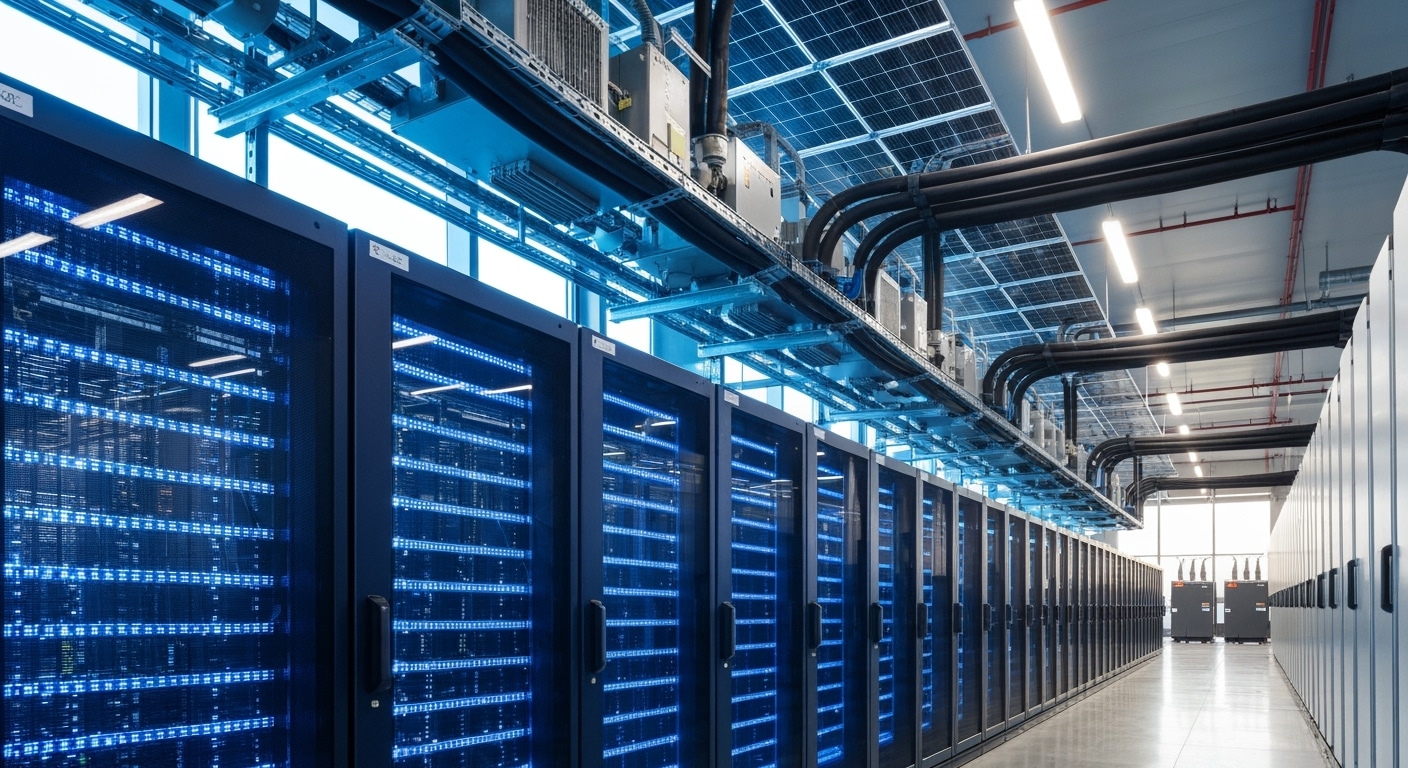
Waterloo Region’s debate over artificial-intelligence data centres has escalated quickly, fuelled by an existing facility in Cambridge, the region’s unresolved water-capacity problem and concern that provincial policy may give large technology companies preferential access to Ontario’s electricity grid.
The public debate is real. Some of the claims circulating around it are not yet established.
Regional council has not approved a new AI data centre, nor did councillors vote this week to allow one to consume millions of litres of municipal water. What the Region’s Sustainability, Infrastructure and Development Committee approved was a request for a detailed staff report examining the economic and environmental implications of data centres.
That report is expected to consider electricity demand, drinking water and wastewater capacity, greenhouse-gas emissions, groundwater, noise, air quality, Indigenous perspectives and possible safeguards. The motion passed unanimously after several amendments.
The request is largely an attempt to answer questions that arguably should have been addressed before Waterloo Region began marketing itself as a destination for high-powered computing.
The controversy nevertheless involves more than a hypothetical project. A major AI-computing facility has already been developed in Cambridge, while another company previously identified Wilmot Township as a possible location for a multibillion-dollar Ontario expansion.
Understanding what is happening requires separating those projects.
There are two different data-centre stories
The most concrete development is a Cambridge facility associated with American AI-cloud company CoreWeave and Canadian artificial-intelligence company Cohere.
The federal government has committed as much as $240 million to Cohere’s wider $725-million computing expansion. Federal documents say Cohere is an anchor customer at a new Cambridge AI-compute facility built and operated by CoreWeave. The government describes the project as part of Canada’s “sovereign AI” strategy—an effort to ensure Canadian companies and researchers have access to computing infrastructure located in Canada rather than relying entirely on foreign providers. Innovation, Science and Economic Development Canada
Industry reporting has placed the Cambridge project’s capacity at approximately 54 megawatts. Waterloo Economic Development Corporation called CoreWeave’s arrival a major regional investment and said the facility includes capacity beyond Cohere’s requirements. Waterloo EDC annual report
The second story involves QScale, a Quebec company that was considering Waterloo Region—and specifically Wilmot Township—for a future Ontario data centre reportedly worth as much as $4 billion.
That possibility attracted attention in 2025 because Wilmot was already at the centre of controversy over the Region’s attempted assembly of approximately 770 acres of farmland. Waterloo EDC said the QScale opportunity was not connected to that land assembly.
QScale founder Martin Bouchard said the company’s technology would not consume water continuously to cool its servers because it would use a closed-loop system. He also suggested waste heat could support greenhouses. As of this article’s publication, however, a possible investment should not be confused with a filed and approved Wilmot development. A company considering Waterloo Region is not the same as a project receiving permission to build. CityNews Kitchener
The current regional review is therefore broader than either company. It is an attempt to develop policy for a category of facilities whose resource demands can vary enormously.
Why the debate became heated now
Timing explains much of the public anger.
Waterloo Region confirmed in January that its Mannheim water system—the service area supplying Kitchener, Waterloo and portions of Cambridge, Woolwich and Wilmot—did not have the development capacity officials had previously assumed.
The problem was not that household taps were about to run dry. It was that the system lacked the resilient surplus required to support projected growth while safely managing equipment failures, maintenance and periods of high demand.
A third-party review confirmed the constraint. The Region then adopted a revised risk-management framework while pursuing repairs, new wells, pumping improvements and longer-term infrastructure. Region of Waterloo
Regional staff have also warned that addressing the shortfall could place pressure on the water capital reserve and future rates. The Region is asking Ontario for financial assistance to reduce those pressures. Regional financial update
Against that background, residents are reasonably asking why housing projects faced water-capacity restrictions while governments and economic-development agencies were pursuing resource-intensive AI infrastructure.
That question deserves a factual answer—not an assurance that all data centres are harmless, but also not an assumption that every facility consumes the same amount of water.
How much water would an AI data centre actually use?
There is no honest single number.
Water consumption depends on the facility’s size, computer density, climate, cooling design and whether it uses evaporative cooling, dry cooling, municipal water, groundwater or reclaimed wastewater.
AI servers produce unusually concentrated heat because racks can contain large numbers of electricity-intensive graphics-processing units. Removing that heat requires a cooling system, but “liquid cooling” does not automatically mean vast quantities of water are continually lost.
CoreWeave says many of its facilities use closed-loop, direct-to-chip liquid cooling. In that design, coolant circulates repeatedly between computing equipment and heat-exchange equipment. The internal coolant is not continuously discarded. CoreWeave
The unresolved question is how the heat is ultimately released outside the building.
A closed loop inside the server room may still transfer heat to cooling towers that consume water through evaporation. Alternatively, a facility can use air-cooled chillers or other “dry” systems that consume much less water but generally require more electricity—particularly during hot weather.
The key measurements are therefore not simply whether a company says its system is closed-loop. Officials need to know:
- How much municipal water the entire facility withdraws annually;
- How much is lost through evaporation;
- How much wastewater or “blowdown” is discharged;
- Whether potable water is used when reclaimed water could be substituted;
- The facility’s peak summer demand;
- Whether backup or emergency cooling changes that demand;
- Whether water use will increase as additional computing equipment is installed.
Neither CoreWeave nor regional officials have published a Cambridge-specific water-use figure detailed enough to answer those questions.
That missing information is more important than generalized estimates borrowed from facilities in hotter American states. A data centre in Arizona using evaporative cooling is not a reliable model for one in Cambridge using a different design.
The appropriate conclusion is not that the Cambridge facility must consume millions of litres every day. It is that the public currently lacks site-specific information needed to verify whether its consumption is small, moderate or substantial.
The 54-megawatt electricity question
Electricity is easier to approximate.
If a 54-megawatt facility operated continuously at its full stated capacity, it would consume roughly 473,000 megawatt-hours of electricity in a year.
That is approximately the annual consumption of more than 56,000 Ontario households using 700 kilowatt-hours per month, the benchmark used in Ontario Energy Board consumer comparisons. The comparison is illustrative: a data centre will not necessarily run at its maximum nameplate capacity every hour, and a household’s demand pattern differs from a continuously operating industrial load. Ontario Energy Board
Still, the comparison demonstrates scale. A large AI data centre is not simply another warehouse. It can resemble a small city in electrical demand while employing far fewer permanent workers.
Ontario’s Independent Electricity System Operator has acknowledged that new AI facilities can require far more electricity than older data centres. Its 2026 outlook says several projects have active system-impact assessments or have begun construction, while interest from developers continues to rise. The IESO also says the number, size and timing of projects remain highly uncertain. IESO Annual Planning Outlook
The Kitchener-Waterloo-Cambridge-Guelph electricity-planning process was completed in July. Any major additional load must be tested against local transformer, station and transmission capacity—not merely Ontario’s total provincial generating supply. Electricity can exist somewhere in Ontario while the wires and substations needed to deliver it to a particular Cambridge site remain constrained.
Will residents pay more for hydro?
Possibly—but an increase is not automatic, and no responsible analysis can assign a Cambridge household bill increase without the facility’s connection agreement and the utility’s cost-allocation details.
The data-centre operator pays for the electricity it consumes. Large industrial users do not simply receive free hydro. They also typically pay for direct connection equipment and site-specific infrastructure.
The harder question is who pays when a project triggers upgrades to the wider network: new transmission equipment, substations or generation that will serve more than one customer.
Ontario’s regulatory system can allocate some connection costs directly to a new customer while treating broader network investments as assets benefiting the system. Those broader costs may eventually enter transmission or distribution rates paid by multiple customer classes.
That is why statements that residents will definitely pay for the Cambridge project are premature—but claims that there is no possible ratepayer exposure are also too confident.
Ontario’s Bill 40, the Protect Ontario by Securing Affordable Energy for Generations Act, 2025, gives the province authority to impose special connection requirements on data centres and other exceptionally large electricity users. Those requirements can consider location, power demand, economic development and job creation. The legislation allows a distributor or transmitter to refuse connection when the prescribed conditions are not met. Ontario law
But Bill 40 does not itself provide a plain, universal guarantee that every dollar of generation, transmission and distribution expansion caused by every data centre will be paid exclusively by that company.
During its consultation, the province specifically asked what pricing mechanisms should ensure that large users requiring system expansion contribute a greater share of infrastructure costs. The fact that Ontario asked the question demonstrates that cost allocation remained a policy issue, not a completely settled protection. Environmental Registry of Ontario
The province has said data centres must provide community and economic benefits before gaining access to scarce grid capacity. As of late July, however, the detailed regulations defining those benefits had not been publicly finalized.
For Waterloo Region residents, the practical answer is this:
A data centre would not cause an immediate surcharge to appear on the next household bill. Over time, however, residential rates could be affected if provincial regulators permit wider grid-expansion costs to be spread among ratepayers. The impact could be limited if the operator finances the necessary upgrades, accepts interruptible service, builds storage or generation, or locates where surplus capacity already exists.
The public should demand the cost-allocation agreement before accepting either side’s assurances.
Could water rates increase?
The same distinction applies to water.
A data centre connected to the municipal system would pay commercial water and wastewater charges based on the applicable rate structure. If it used enough water to require new pipes, pumping capacity or treatment infrastructure, development charges, direct agreements or other fees could recover some of those costs.
But if the Region undertook broader water-system expansion that also served growth generally, part of the cost could be financed through development charges, reserves, debt or future water rates.
Waterloo Region has already warned of potential rate pressure from its existing capacity problem. A major new industrial customer could improve utility revenue if existing infrastructure can serve it efficiently. It could worsen costs if it consumes scarce peak capacity or requires accelerated expansion.
The decisive issue is not simply annual litres. Peak-day demand and location matter. A facility using modest quantities in an unconstrained Cambridge service area could have a different impact from one requiring large withdrawals from the constrained Mannheim system.
If a company takes water directly from the environment rather than purchasing it through the municipal system, Ontario generally requires a Permit to Take Water for withdrawals above 50,000 litres per day. The province—not regional council—administers that permitting system. Ontario permit requirements
What is the province’s role?
Ontario holds several of the most consequential powers.
The province controls the statutory framework governing municipal planning, electricity connections, environmental approvals and direct water takings. It can also issue ministerial zoning orders, although there is no public evidence one has been issued for the Waterloo Region projects discussed here.
Its responsibilities include:
- Establishing criteria for large data centres seeking grid connections;
- Regulating electricity transmitters and distributors through provincial law and the Ontario Energy Board;
- Overseeing IESO assessments of grid reliability;
- Issuing environmental permissions;
- Regulating large direct withdrawals from groundwater or surface water;
- Establishing planning rules municipalities must follow;
- Deciding whether provincial funding supports infrastructure needed for growth.
Municipalities retain authority over zoning, site planning, building permits, noise rules and local servicing within the limits of provincial law. The Region controls municipal drinking-water and wastewater services and can determine whether sufficient servicing capacity exists.
Regional council’s new report cannot replace provincial regulation or prevent a legally permitted development on its own. It can identify risks, establish water and wastewater conditions, guide advocacy and help the cities and townships create defensible local standards.
What are the realistic benefits?
Large data centres bring substantial construction spending, commercial assessment and demand for electrical, mechanical, security and maintenance services.
They can also support a regional technology ecosystem. Waterloo Region contains universities, AI researchers, startups and established technology companies that depend on computing capacity. Canadian-controlled or Canadian-located computing can reduce dependence on foreign infrastructure and give companies more control over sensitive data.
The federal government’s support for Cohere is based on that strategic argument.
The employment claim requires more scrutiny. Data centres create significant construction work but typically employ relatively few people once operational compared with factories occupying similar land or consuming similar electrical capacity.
The economic question should therefore be framed as value per scarce resource:
- How many permanent jobs will the project create?
- What will those jobs pay?
- How much property-tax revenue will it generate?
- Will local companies and researchers receive usable computing access?
- Will Canadian data actually be stored and governed in Canada?
- How much electricity and water will be consumed per permanent job?
- Would the same grid capacity create more employment if assigned to another industry?
- Will waste heat be recovered, or merely released?
- Who pays if promised investment or employment does not materialize?
A large capital-investment announcement is not, by itself, proof of a large community benefit.
The Cambridge pond incident intensified distrust
The debate also intensified after an odorous, milky-white substance appeared in a stormwater pond beside the data-centre property at 17 Vondrau Drive in Cambridge in July.
The Ministry of the Environment, Conservation and Parks, Waterloo Region and the City of Cambridge investigated. The ministry said the substance had stopped entering the pond, and the Region reported that the municipal drinking-water system was not affected. Cleanup work continued, but public reporting did not initially identify the substance or explain its source. CambridgeToday
The incident does not prove that AI cooling systems contaminated regional drinking water. The available evidence does not establish that.
It does illustrate the transparency problem. When residents are told a facility is environmentally advanced but cannot obtain clear information about an unusual discharge beside it, suspicion predictably grows.
What should residents demand?
The most useful debate is not “AI or no AI.” Data centres already exist, and digital services require physical infrastructure somewhere.
The relevant question is whether Waterloo Region should accept a particular facility, in a particular location, using a particular cooling system, under a particular cost agreement.
Before supporting further hyperscale development, local and provincial officials should require public disclosure of:
- Maximum and expected electricity demand;
- Annual and peak-day water consumption;
- The cooling and heat-rejection design;
- Water Usage Effectiveness and Power Usage Effectiveness targets;
- The source and quality of cooling water;
- Wastewater volumes and chemical additives;
- Backup-generator emissions and testing schedules;
- Noise modelling at the property line;
- Permanent employment estimates;
- Tax and economic benefits;
- Grid and water infrastructure costs;
- The portion paid by the operator;
- Performance guarantees and penalties if commitments are missed;
- Plans for equipment failure, spills and emergency cooling;
- Whether waste heat will actually be reused.
Until those numbers are published, it is impossible to determine whether a specific facility is a manageable industrial user or an unreasonable burden on a constrained community.
The bottom line
Waterloo Region is not currently voting on a new regional AI data-centre approval. It is studying how these facilities should be evaluated.
At least one significant AI-computing project is already tied to Cambridge through CoreWeave and Cohere. QScale has considered a separate expansion in Wilmot, but public discussion has sometimes treated that possibility as though a final development were already approved.
The Cambridge facility’s potential electrical demand is substantial. If the reported 54-megawatt capacity were used continuously, its annual consumption would be comparable to that of tens of thousands of homes.
Its municipal water impact cannot presently be calculated from public information. Closed-loop liquid cooling can sharply reduce continuous water consumption, but that description alone does not reveal how the facility rejects heat or how much water is ultimately evaporated.
Residents will not automatically receive higher hydro or water bills because a data centre exists. They could face indirect pressure if public utilities and provincial regulators allow broader infrastructure costs to be spread across other customers.
That possibility makes the province’s unfinished connection rules and the Region’s pending report important.
The correct standard is not whether data centres are inherently good or bad. It is whether their private benefits justify their public demands—and whether the companies earning revenue from AI are required to pay the full cost of the infrastructure that makes it possible.